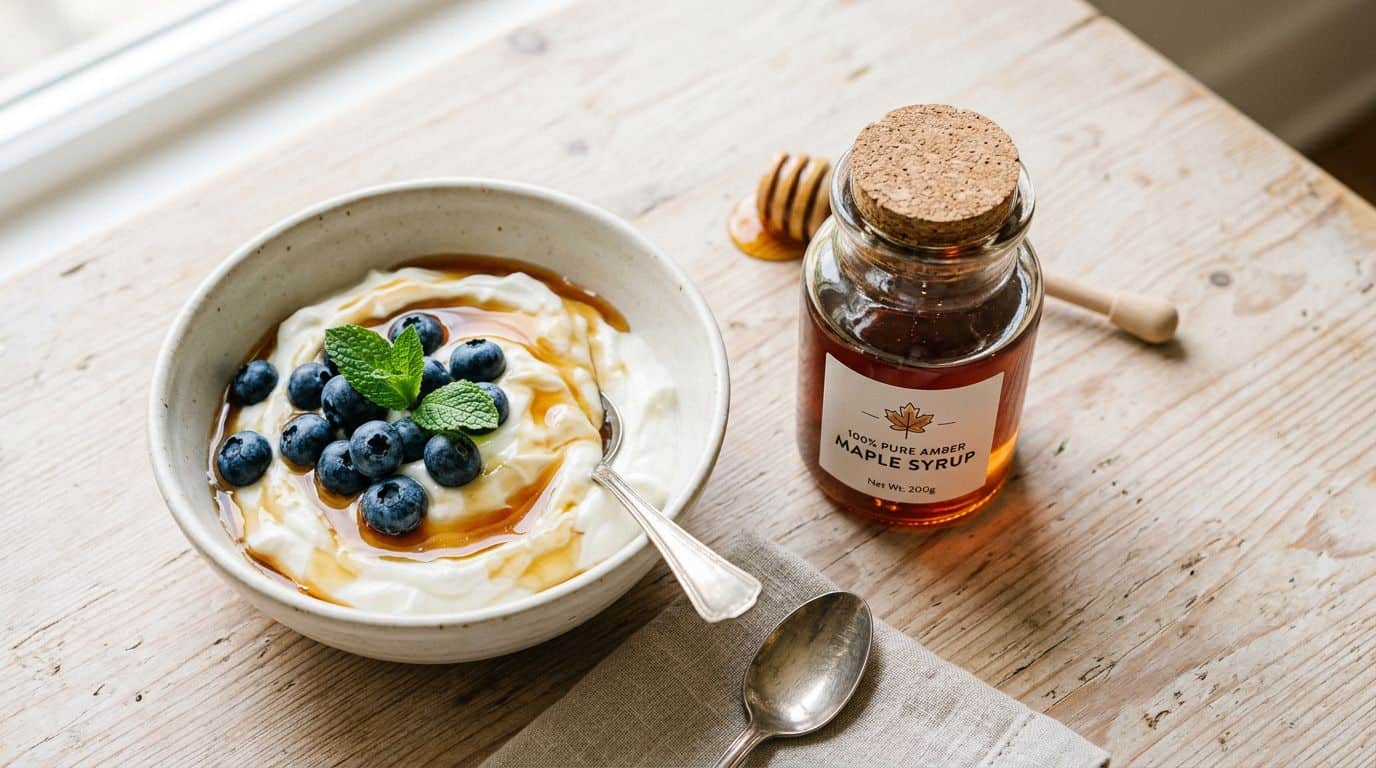

What is maple syrup?
Maple syrup is a naturally sweet liquid made by concentrating the sap of maple trees – most commonly the sugar maple tree. The sap is collected in early spring and then boiled down until the water evaporates, leaving behind a thick, amber-colored syrup with a rich, caramel-like flavor.
Pure maple syrup contains only one ingredient: maple sap.
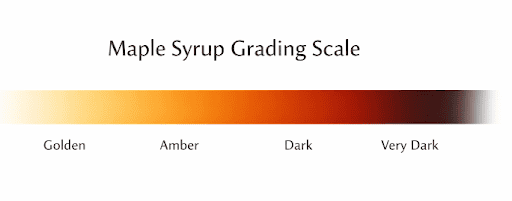
Maple syrup comes in several grades, which reflect flavor intensity and color rather than quality (1).
- Golden: Lightest color, delicate flavor.
- Amber: Richer flavor, commonly used for pancakes and waffles.
- Dark: Robust, more intense maple taste.
- Very Dark: Strongest flavor, often used for cooking or baking.
All grades are safe and nutritionally similar – the choice simply depends on your preferred flavor.
Is maple syrup safe for pregnancy?
Yes!
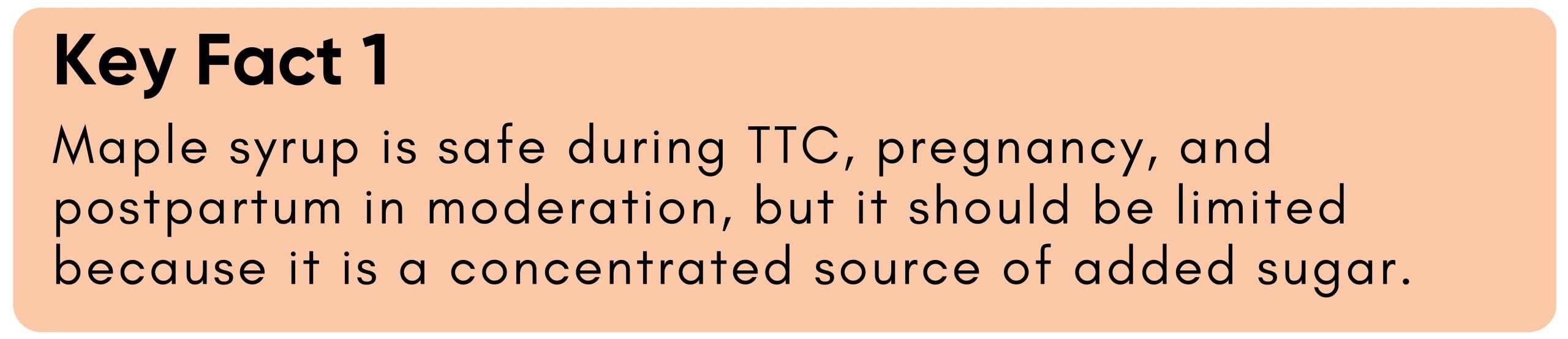
Maple syrup is safe to consume during pregnancy, TTC, and postpartum when used in moderation. It is considered a natural sweetener and can be safely included in a balanced pregnancy diet.
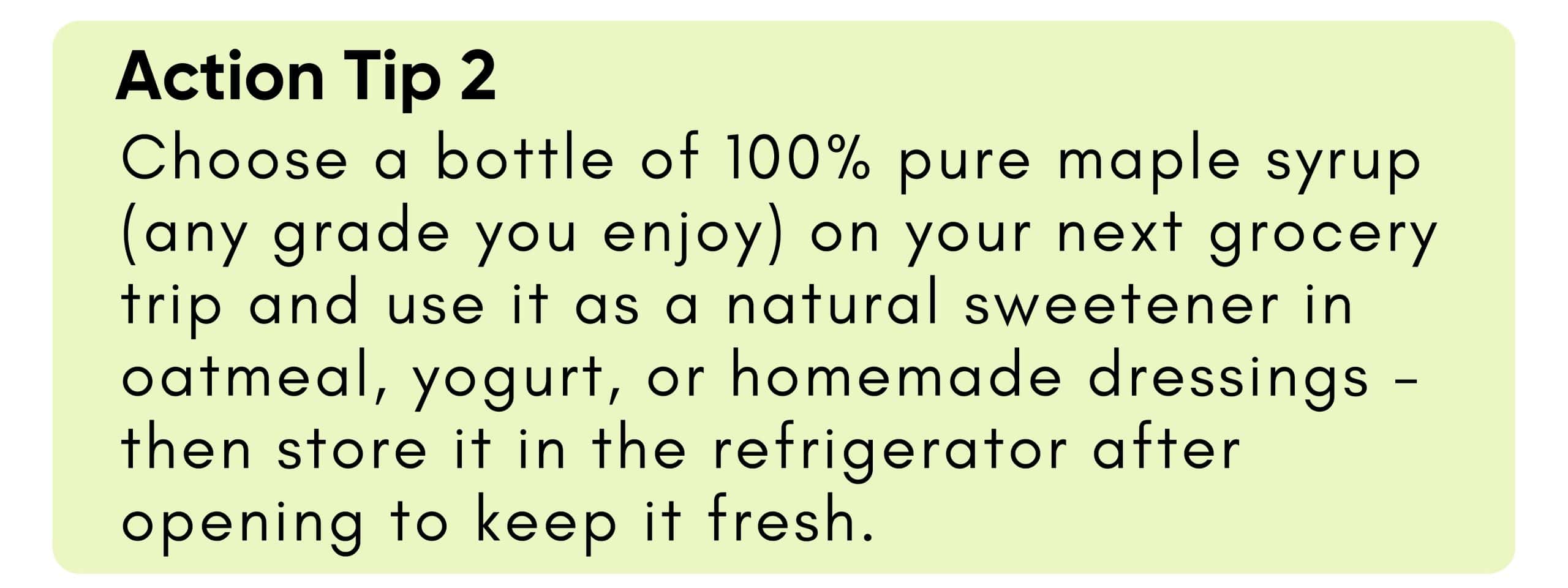
Because maple syrup is essentially a form of sugar, the main consideration during pregnancy is portion size. Excessive intake of added sugars can contribute to blood sugar spikes and fatigue. Using maple syrup in small amounts (such as oatmeal, yogurt, or homemade dressing) is safe and appropriate.
Is maple syrup pasteurized or otherwise heat-treated?
Maple syrup is not pasteurized in the traditional sense. Instead, it becomes microbiologically safe through the boiling reduction process used during production.
Fresh maple sap is collected from sugar maple trees and then boiled until most of the water evaporates – typically reaching around 219F. This high heat destroys microorganisms and concentrates the sugars, creating the thick, amber syrup we know (3).
Because of this intense boiling, maple syrup does not require pasteurization like milk or juice. However, once opened, store it in the refrigerator to prevent mold growth. If mold appears, the syrup should be discarded (2).
Commercial maple syrup sold in the United States is considered heat-treated and shelf-stable when unopened (2).
Is maple syrup more nutritious than table sugar?
Not significantly.
Maple syrup does contain small amounts of minerals and trace amounts of a few vitamins, but these nutrients appear in very small quantities and do not make maple syrup a “nutritious” sweetener (4). In practical terms, maple syrup and table sugar function similarly in the body: both are concentrated sources of added sugar and can contribute to blood sugar spikes when consumed in excess.
The main nutritional difference is that maple syrup has a slightly lower glycemic index than table sugar, meaning it may cause a slower rise in blood glucose (5). However, this difference is modest and does not make maple syrup a health food or a preferred sweetener during pregnancy.
Maple syrup can be enjoyed in small amounts for flavor, but you shouldn’t rely on it for meaningful nutrients.

Does the sugar in maple syrup count as natural or added sugar?
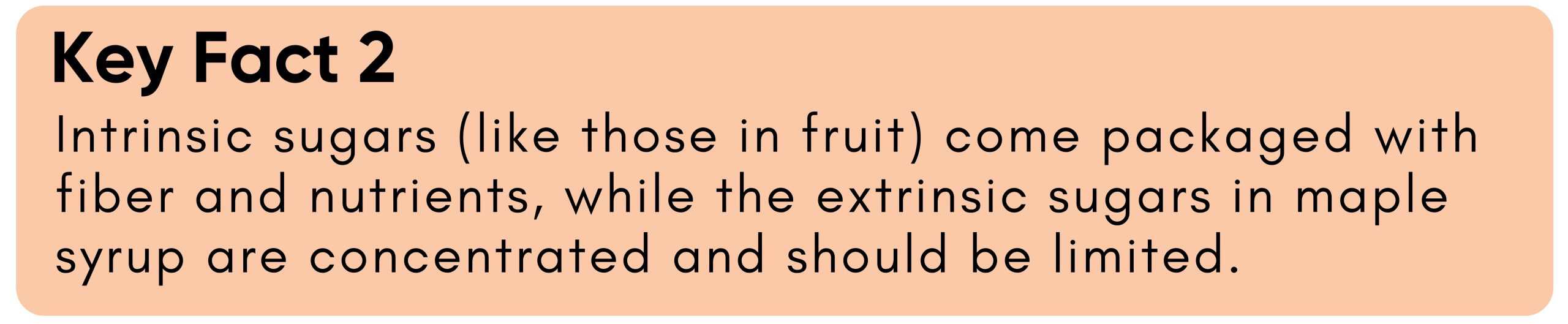
Maple syrup is considered an added sugar, while fruit, for example, contains intrinsic sugar. Even though both come from natural sources, the way sugar exists in each food differs greatly.
In fruit, sugar is naturally built into the food’s structure alongside fiber, water, vitamins, and antioxidants. This combination slows digestion, supports blood sugar control, and provides meaningful nutrition (6).
Maple syrup, however, is a concentrated sweetener. Its sugars are extrinsic, meaning they exist outside a whole-food matrix. During production, water is boiled off, leaving behind a dense source of sugar with only trace nutrients (4). Extrinsic sugars are digested quickly and can contribute to blood sugar spikes when consumed in excess.
During pregnancy, choosing foods with intrinsic sugars (like fruit) supports steadier energy and better blood sugar balance (7). You can still enjoy maple syrup in small amounts for flavor.
How much maple syrup is a reasonable serving?
A reasonable serving of maple syrup is 1 tablespoon (4). This amount provides sweetness without contributing excessive added (extrinsic) sugar. Because maple syrup is a concentrated sweetener, even small amounts can impact blood glucose – especially during pregnancy, when insulin sensitivity naturally shifts (6).
One tablespoon of maple syrup contains roughly 13-15 grams of carbohydrate, which is approximately one carbohydrate serving (4). This makes it easy to fit into balanced meals or snacks without exceeding recommended added sugar or carbohydrate limits.
During pregnancy, TTC, and postpartum, keeping portions to 1 tablespoon or less at a time supports steadier blood sugar levels.
How does maple syrup compare to other sweeteners?
| Maple Syrup
1 Tbsp |
Agave
1 Tbsp |
Honey
1 Tbsp |
White Sugar
1 Tbsp |
|
| Kcal | 52 kcal | 64.2 kcal | 63.8 kcal | 50.4 kcal |
| Protein | 0.008 g | 0.018 g | 0.063 g | 0 g |
| Fat | 0.012 g | 0.093 g | 0 g | 0.039 g |
| Carbs | 13.4 g | 15.81 g | 17.3 g | 12.54 g |
| Fiber | 0 g | 0.042 g | 0.042 g | 0 g |
| Calcium | 20.4 mg | 0.207 mg | 1.26 mg | 0.126 mg |
| Magnesium | 4.2 mg | 0.207 mg | 0.42 mg | 0 g |
| Potassium | 42.4 mg | 0.828 mg | 0.84 mg | 0.252 mg |
*Information in the table gathered from USDA FoodData Central.
So, what is the best sweetener to use?
There isn’t one “best” sweetener; the healthiest choice depends on how much you use, what you pair it with, and your blood sugar needs. All liquid sweeteners (maple syrup, honey, agave) and granulated sugar function as extrinsic sugars, meaning they exist outside a whole-food matrix and can raise blood glucose quickly (6).
The table above shows that each sweetener has slightly different calories, carbohydrate amounts, and trace nutrients, but none offer enough vitamins or minerals to be considered nutritious. The differences between them are small. What matters most is portion size.
The best sweetener is the one you use intentionally and sparingly and paired with protein or fiber to support steadier blood sugar.
Maple syrup can absolutely fit into a balanced pregnancy diet, but so can honey, agave, or even small amounts of white sugar. The key is using sweeteners for flavor, not nutrition, and choosing whole foods (like fruit) when you want sweetness and nourishment.
Can maple syrup fit with gestational diabetes, PCOS/PMOS, or insulin resistance?
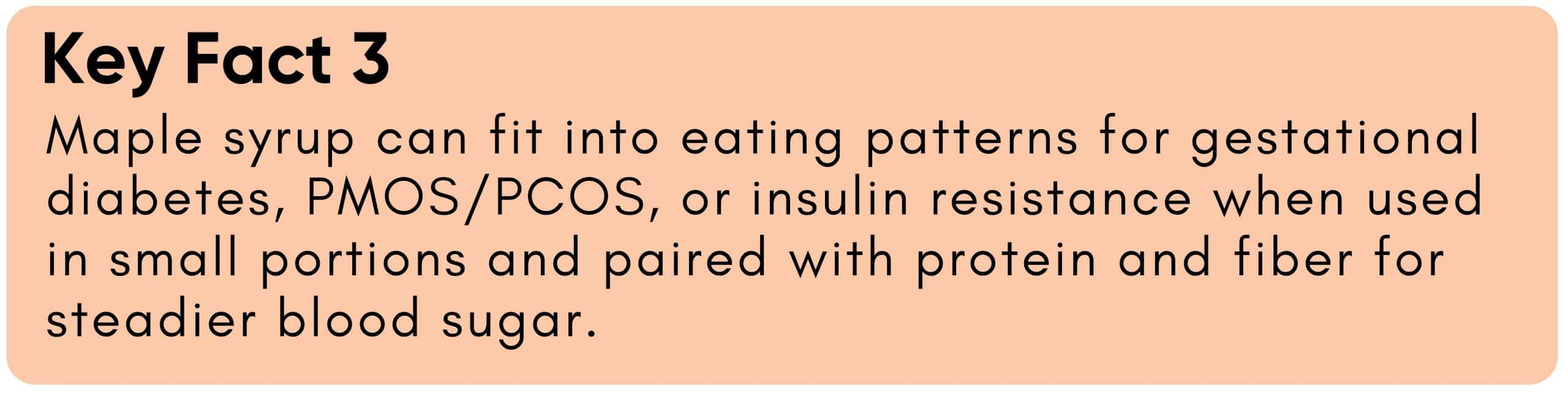
Maple syrup can fit into nutrition plans for gestational diabetes , PCOS/PMOS , or insulin resistance – but only in small, measured amounts. These conditions all involve reduced insulin sensitivity, meaning the body has a harder time managing blood glucose after eating carbohydrate-rich foods (8). Because maple syrup is a concentrated source of added sugar, it can raise blood glucose more quickly than foods containing intrinsic sugars, fiber, or protein (6).
A standard portion of maple syrup – 1 tablespoon – contains roughly 13-15 grams of carbohydrate, or about one carbohydrate serving (4). When included intentionally in a balanced meal with protein, fiber, and fats, this amount can fit many blood sugar management eating patterns.
For individuals managing gestational diabetes, PCOS/PMOS, or insulin resistance, the key is portion control and meal composition. Using maple syrup as a flavor accent rather than a primary carbohydrate source helps support steadier blood sugar responses. Pairing it with foods like yogurt, oatmeal, nuts, or animal protein alongside the food it is in can further slow absorption (6).
How to shop for maple syrup
With so many maple syrup products on store shelves, the most important step is knowing how to tell pure maple syrup from maple-flavored or blended sweeteners.
When choosing maple syrup, look for bottles labeled “100% pure maple syrup,” which means the product contains only boiled maple sap. Many store options – like pancake syrup, table syrup, or maple-flavored syrup – are not real maple syrup.
Pure maple syrup will list only one ingredient and is sold as Grade A in Golden, Amber, Dark, or Very Dark varieties, all of which are nutritionally similar (1).
How to store it
Pure maple syrup is shelf-stable until opened, but you must refrigerate it after opening to prevent mold growth. Once refrigerated, it stays for several months and maintains its flavor and quality. If mold develops, discard the syrup rather than reheating or straining it (2).
The Bottom Line
- Maple syrup is safe across TTC, pregnancy, and postpartum when used in small, intentional portions.
- It is considered added sugar, so portion size matters for blood sugar balance and overall health.
- It does not provide significantly more benefits than other sugars and functions the same way in the body as regular white sugar.
- Maple syrup can fit into gestational diabetes, PCOS/PMOS, and insulin resistance when paired with protein and fiber. A reasonable serving is 1 tablespoon, which counts as about one carbohydrate serving.
- All Grade A varieties – Golden, Amber, Dark, and very Dark – are safe and nutritionally similar.